How does wanting to migrate — but not being able to — shape people's lives?

Researching
Involuntary
Immobility
Large numbers of young people around the world, particularly in developing countries, wish to migrate but lack the capacity to do so.
This phenomenon has been called involuntary immobility, and poses important challenges for human development. Yet, while immobility is numerically larger than migration, it is for now a largely unexplored area of research.
The PATHWAYS project fills this gap by conceptualizing and empirically investigating the extent to which involuntary immobility affects human development.
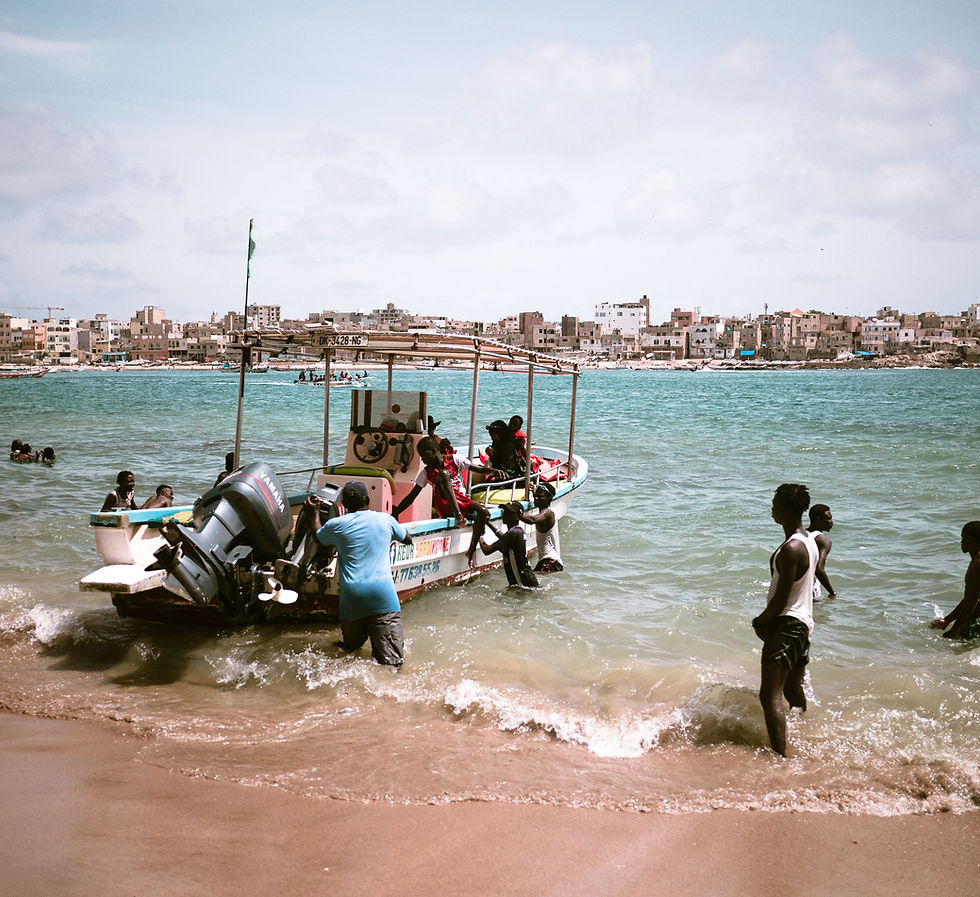
We focus our study in southern Senegal, more specifically the Casamance region, a context where migration is closely linked to social status and successful adulthood.
About the PATHWAYS research project
Research Objectives
01
Rethinking Involuntary Immobility
Involuntary immobility has so far been treated as a binary and static outcome.
The first research objective is to conceptualise and measure involuntary immobility as a continuum, varying in intensity, concreteness, form, and temporal scope.
This will allow to both gain a deeper understanding of the nuances of involuntary immobility and to quantify the extent of this phenomenon and its potential implications.
02
Consequences of Involuntary Immobility
Prior qualitative fieldwork has identified a potential negative association between involuntary immobility and well-being.
The second research objective is to study the consequences of involuntary immobility on multi-dimensional subjective well-being and mental health.
Building on the project's mixed-methods longitudinal design, we combine quantitative and qualitative analyses to study how involuntary immobility associates with the cognitive, emotional, and eudaimonic dimensions of subjective well-being.
03
Responses to Involuntary Immobility
The third research objective is to examine how perceived involuntary immobility shapes aspiration adaptation and behavioural responses.
We use a multi-dimensional aspirations framework to test whether an aspiration (e.g., wealth) is substituted for another (e.g., education), and examine responses such as professional re-orientation or reconsideration of migration alternatives.
We further explore what drives selection into an "aspiration trap," testing whether this stems from cognitive biases, personality traits, or access to information about alternatives to migration.

Why southern Senegal?
We focus on southern Senegal, specifically the region of Casamance, as prior reports have shown that a large proportion of the young adult population there would like to migrate internationally.
We build on prior qualitative fieldwork from West Africa that has shed light on a potentially negative association between involuntary immobility and subjective well-being.
We focus on three research locations:
Ziguinchor
Ziguinchor is the capital of the Ziguinchor Region, and the chief town of the Casamance area of Senegal, lying at the mouth of the Casamance River.
It has a population of more than 200,000 people.
Kolda
Kolda is a mid-sized regional capital in southern Senegal's Casamance area, known for its peanut and cotton trade, ethnic diversity, and Casamance River proximity.
It has a population of around than 100,000 people.
Bagadadji (villages)
Roughly 30 rural villages clustered around Bagadadji, a small Casamance market town, characterized by subsistence farming, Pulaar-speaking communities, dispersed compounds, and limited infrastructure connecting them to larger urban centers.

Research with and for young adults
The research project lasts 4 years and consists of three waves of qualitative fieldwork, two waves of survey data collection and a RCT intervention (in collaboration with the Luxembourg Institute of Socio-Economic Research - LISER) aimed at improving perceptions of local labour market opportunities.
Mixed-methods longitudinal research setup:
Prior
fieldwork
2022-23
Survey
wave #1
Dec - 2024
In-depth
interviews #1
Mar - 2025
Intervention
(RCT)
Jan - 2026
Focus
groups
Apr - 2026
Survey wave #2
Jul - 2026
In-depth interviews #2
Oct - 2026
Work packages, explained
The project is structured in seven work packages:
Package 1: Conceptual Framework
Develops the overarching framework linking involuntary immobility to human development. Synchronizes all other work packages to ensure their methods and conclusions reinforce one another. Integrates insights from the literature review, original data collection, and later analyses. Acts as the connective thread running through the entire project.
Package 2: State of the Art & Secondary Data Analysis
Reviews existing literature and survey data on involuntary immobility and migration aspirations. Builds on prior work to refine survey instruments for the project. Conducts secondary analyses of existing panel data to operationalize and quantify involuntary immobility. Identifies key gaps that motivate the collection of new longitudinal data.
Package 3: Longitudinal Quantitative Survey
Collection of two-wave panel survey data (18 months apart) from youth aged 18–39 across three locations in southern Senegal. Enables tracking of who maintains, abandons, or acts on migration plans over time. Measures consequences for well-being, aspirations, and forward-looking behaviors. Provides the quantitative basis for statistical analysis.
Package 4: Longitudinal Qualitative Fieldwork
Repeated in-depth interviews with a stratified sub-sample of survey respondents. Builds trust over time to capture subtle decision-making processes and psycho-social change. Complements survey data by revealing mechanisms behind observed statistical relationships. Re-interviews the same individuals twice across the project's timeframe.
Package 5: Aspirations & Behavioral Adaptation
Explores how failed migration attempts or perceived immobility reshape life and migration-related aspirations. Assesses how these adapted aspirations translate into behavioral changes and alternative actions. Investigates cognitive biases (e.g. loss aversion, status quo bias) shaping coping responses.
Package 6: Project Management & Coordination
Oversees overall project management, including team coordination and researcher recruitment.
Ensures work packages stay aligned with the project's timeline and milestones.
Package 7: Dissemination & Valorization
Shares findings through scientific articles, interdisciplinary workshops, and media outreach. Tailors communication formats to reach both academic and non-academic audiences. Makes survey data publicly available following FAIR standards.
NEW!
23.09.2026

The project's documentation has been published open access on Zenodo.
This document describes both the overall scope of the PATHWAYS project and how its data collection was carried out. It is intended as a reference for academic researchers and data users who wish to interpret the data correctly and understand their scope and limitations.
Each data source is documented in a dedicated section of this report. A separate codebook (Appendix B) covers the survey variables in full detail.
Publications

The well-being toll of revealed involuntary immobility: a quantitative study
Nicolás Caso and Sorana Toma
Globalization and Health

Involuntary immobility and well-being: a scoping review of existing literature and future research directions
Lise Vanden Hautte, Charlotte Scheerens, Ilse Ruyssen & Sorana Toma
Globalization and Health

Involuntary immobility and multidimensional subjective well-being: a longitudinal study
Nicolás Caso, Charlotte Scheerens, Ilse Ruyssen & Sorana Toma
Working paper

Research team
The project is led by a partnership between Ghent University (Belgium) and the University for Continuing Education Krems (Austria)

Co-Principal Investigator
Associate Professor at the Department of Public Health and Primary Care at Ghent University.
Her research focuses on the intersection of migration and health(care), with particular attention to ethno-racial inequalities and the impact of migration experiences and discrimination on mental health and well-being.
Sorana Toma
Co-Principal Investigator
Associate Research Professor in Migration Economics at the Department of Economics of Ghent University.
Coordinator of the CliMigHealth International Thematic Network, which unites scholars from multiple disciplines around the world working on the nexus between climate change, migration, and healthcare.

Ilse Ruyssen

Charlotte Scheerens
Postdoctoral researcher
Postdoctoral researcher at the Department of Public Health and Primary Care at both Ghent University and KULeuven.
Her research focuses on temperature and pollution impacts on chronic obstructive pulmonary disease (COPD), integrated and equitable primary healthcare approaches, planetary health, and climate change–related health risks.

PhD fellow
PhD fellow in Economics and Health sciences at Ghent University.
His research focuses on the development implications of involuntary immobility.
Prior to his PhD, he worked as a Research Assistant at the Peace Research Institute Oslo (PRIO) Migration Centre for two ERC-funded projects: MIGNEX and FUMI.
Nicolás Caso

Mathias Czaika
Co-Principal Investigator
Professor of Migration and Integration and Head of the Department of Migration and Globalization at Krems University.
His expertise covers the drivers and dynamics of international migration processes, decision-making in the field of migration, migration policy-making and policy impacts, as well as the migration of highly skilled workers, asylum seekers, and refugees.

Naiara Rodríguez-Peña
Postdoctoral researcher
Assistant Professor at the University of Deusto and Postdoctoral researcher at Krems University.
Her work focuses on the formation and realisation of migration and stay aspirations, the theorisation of capabilities, and the two-way relationship between development and migration.
.png)
Murray Kennedy
Research Assistant
BSc in Psychology and MSc in Social and Cultural Psychology.
His research focuses on developing items to understand social and cognitive facets of migration decision-making and behavior. Murray’s other research interests include using advanced quantitative methods to understand the political economy of migration and poverty in Sub-Saharan Africa.
Project Updates




Connect with us
GENERAL CONTACT
The PATHWAYS research project is hosted at the Department of Public Health and Primary Care from Ghent University
Ghent University, Faculty of Medicine and Health Sciences, Department of Public Health and Primary Care, Campus UZ-Ghent, Entrance 42, 6th Floor, Corneel Heymanslaan 10, 9000, Gent, Belgium.
Tel.: 0032 9 332 36 28
PROJECT CONTACT
For inquiries with regards to the research project, please contact directly Nicolás Caso from Ghent University at nicolas.caso@ugent.be
